German plurals: the five patterns and how to guess them
German nouns form their plural in five ways: with -e (der Tag, die Tage), with -(e)n (die Lampe, die Lampen), with -er (das Kind, die Kinder), with no ending (der Lehrer, die Lehrer) or with -s (das Auto, die Autos), and some patterns add an umlaut. You cannot always predict the plural, but the gender and the ending of the noun make a good guess likely: feminine nouns almost always take -(e)n, masculine nouns usually take -e, and short neuter nouns often take -er.
What are the five German plural patterns?
Here are the five patterns at a glance, with the nouns that typically use them.
| Pattern | Examples | Typical for |
|---|---|---|
| -e, often with umlaut | der Tag, die Tage; der Zug, die Züge | masculine, some neuter |
| -n or -en | die Lampe, die Lampen; die Zeitung, die Zeitungen | feminine |
| -er, with umlaut when possible | das Kind, die Kinder; das Haus, die Häuser | short neuter nouns |
| no ending, sometimes umlaut | der Lehrer, die Lehrer; der Vater, die Väter | nouns in -er, -el, -en, -chen, -lein |
| -s | das Auto, die Autos; das Handy, die Handys | vowel endings, loanwords |
Whatever the pattern, the article in the plural is always die. The gender of the singular disappears, which is why you need the singular to learn the gender, and you need to learn the plural on its own. The der, die, das rules cover the singular side.
Ich habe nächste Woche zwei Termine.
I have two appointments next week.
Die Züge nach München fallen heute aus.
The trains to Munich are cancelled today.
How do you form the plural of feminine nouns?
This is the easy one. Almost every feminine noun takes -n or -en, and there is no umlaut:
- Nouns ending in -e add -n: die Tasche, die Taschen, die Woche, die Wochen.
- Most others add -en: die Frau, die Frauen, die Zeitung, die Zeitungen, die Tür, die Türen.
- Female forms in -in double the n: die Kollegin, die Kolleginnen.
There are two small groups of exceptions. A small group of short feminine nouns take -e with an umlaut, and several of them are everyday words: die Hand, die Hände, die Stadt, die Städte, die Nacht, die Nächte, die Wand, die Wände, die Wurst, die Würste. And two family words take only an umlaut: die Mutter, die Mütter and die Tochter, die Töchter.
Die Rechnungen liegen auf dem Tisch.
The bills are on the table.
Wir waschen uns die Hände.
We are washing our hands.
How do you form the plural of masculine nouns?
Masculine nouns usually take -e, and many short ones add an umlaut as well. Sadly, you cannot see from the singular whether the umlaut comes.
- Without umlaut: der Tag, die Tage, der Tisch, die Tische, der Termin, die Termine.
- With umlaut: der Zug, die Züge, der Stuhl, die Stühle, der Arzt, die Ärzte, der Platz, die Plätze.
Three groups follow other patterns, and they are easy to recognise:
- Nouns ending in -er, -el or -en usually take no ending: der Lehrer, die Lehrer, der Schlüssel, die Schlüssel, der Kuchen, die Kuchen. A few add an umlaut: der Vater, die Väter, der Apfel, die Äpfel, der Garten, die Gärten.
- Masculine nouns ending in -e, and those in -ent, -ant and -ist, take -n or -en: der Kollege, die Kollegen, der Student, die Studenten, der Tourist, die Touristen. These nouns also change in the singular; see the n-declension.
- A small group takes -er with umlaut: der Mann, die Männer, der Wald, die Wälder.
How do you form the plural of neuter nouns?
Short neuter nouns split into two groups. Many take -er, always with an umlaut when the vowel allows one. Many others take -e.
- With -er: das Kind, die Kinder, das Buch, die Bücher, das Haus, die Häuser, das Land, die Länder, das Glas, die Gläser.
- With -e: das Jahr, die Jahre, das Brot, die Brote, das Spiel, die Spiele, das Problem, die Probleme.
Longer neuter nouns are easier, because their ending tells you what to do:
| Ending | Plural | Examples |
|---|---|---|
| -chen, -lein, -er, -el, -en | no ending | das Mädchen, die Mädchen; das Zimmer, die Zimmer |
| -ment | -e | das Dokument, die Dokumente |
| -nis | -nisse | das Ergebnis, die Ergebnisse |
| -um | -en instead of -um | das Museum, die Museen; das Zentrum, die Zentren |
A handful of common neuter nouns take -en: das Bett, die Betten, das Ohr, die Ohren, das Hemd, die Hemden. If you want to know which ending a noun has in the singular and what it tells you, see German noun endings that tell you the gender.
Die Kinder haben heute keine Schule.
The children have no school today.
Bitte bringen Sie alle Dokumente mit.
Please bring all the documents with you.
When do German plurals end in -s?
The -s plural is the odd one out, and it is used for words that do not fit the German sound system well:
- Most nouns ending in a vowel other than -e: das Auto, die Autos, das Kino, die Kinos, das Büro, die Büros, die Oma, die Omas.
- Many words from English and French: das Hotel, die Hotels, das Ticket, die Tickets, der Job, die Jobs, das Team, die Teams.
- Short forms: der Lkw, die Lkws, die Kita, die Kitas.
- Family names: Wir sind heute bei Müllers eingeladen. means "We're invited to the Müllers' today."
What happens to plurals in the dative?
In the dative plural, nouns take an extra -n. If the plural already ends in -n or in -s, nothing is added.
| Nominative plural | Dative plural |
|---|---|
| die Kinder | mit den Kindern |
| die Freunde | mit meinen Freunden |
| die Tage | in den nächsten Tagen |
| die Frauen | mit den Frauen |
| die Autos | mit den Autos |
In den nächsten Tagen bekommen Sie einen Brief von uns.
You will get a letter from us in the next few days.
Am Wochenende bin ich mit meinen Freunden unterwegs.
At the weekend I'm out with my friends.
This -n is easy to forget in speech, and people will still understand you, but it matters in writing and in exams. The German dative case shows when you need it.
How does Linota help with German plurals?
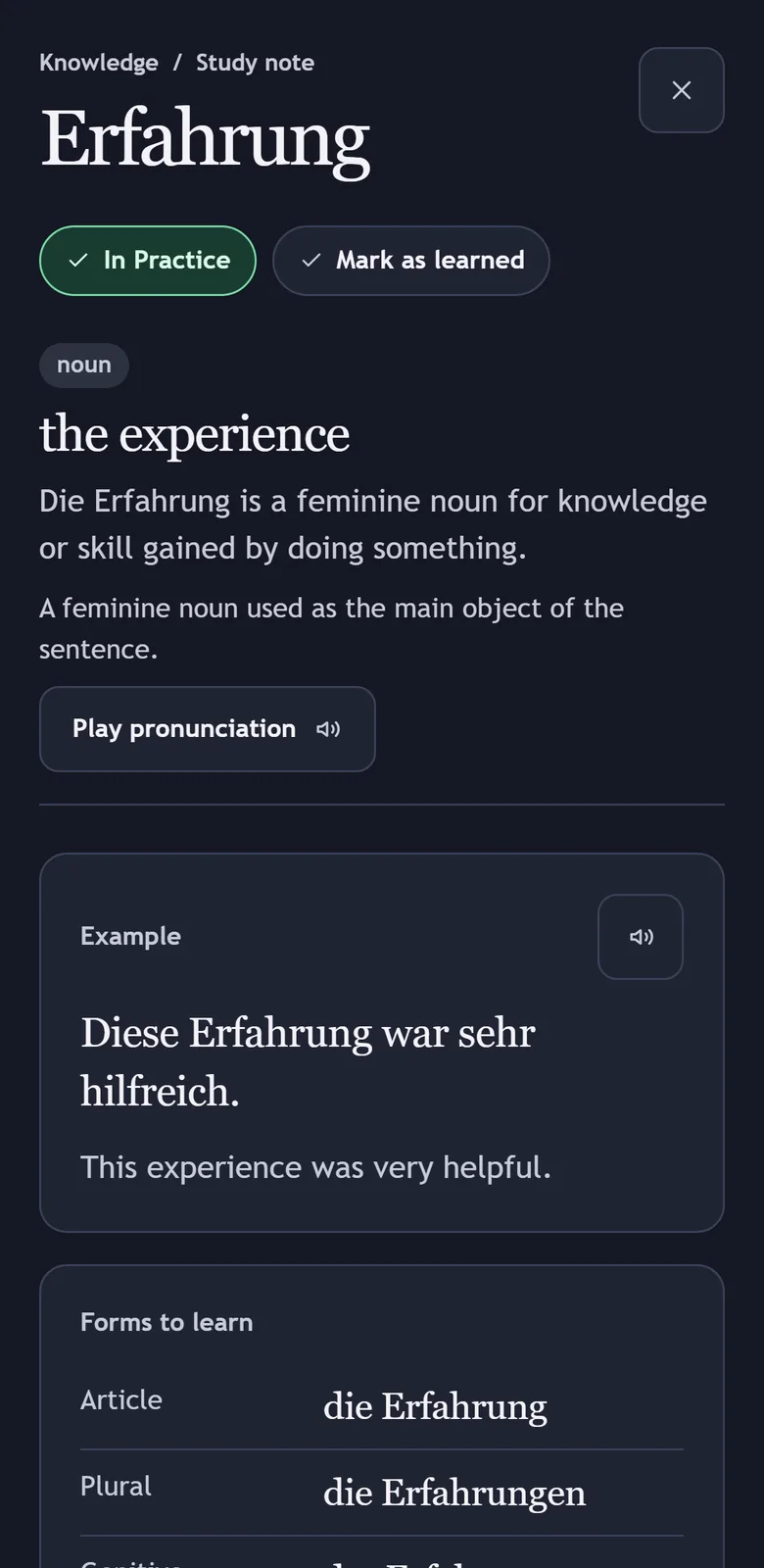
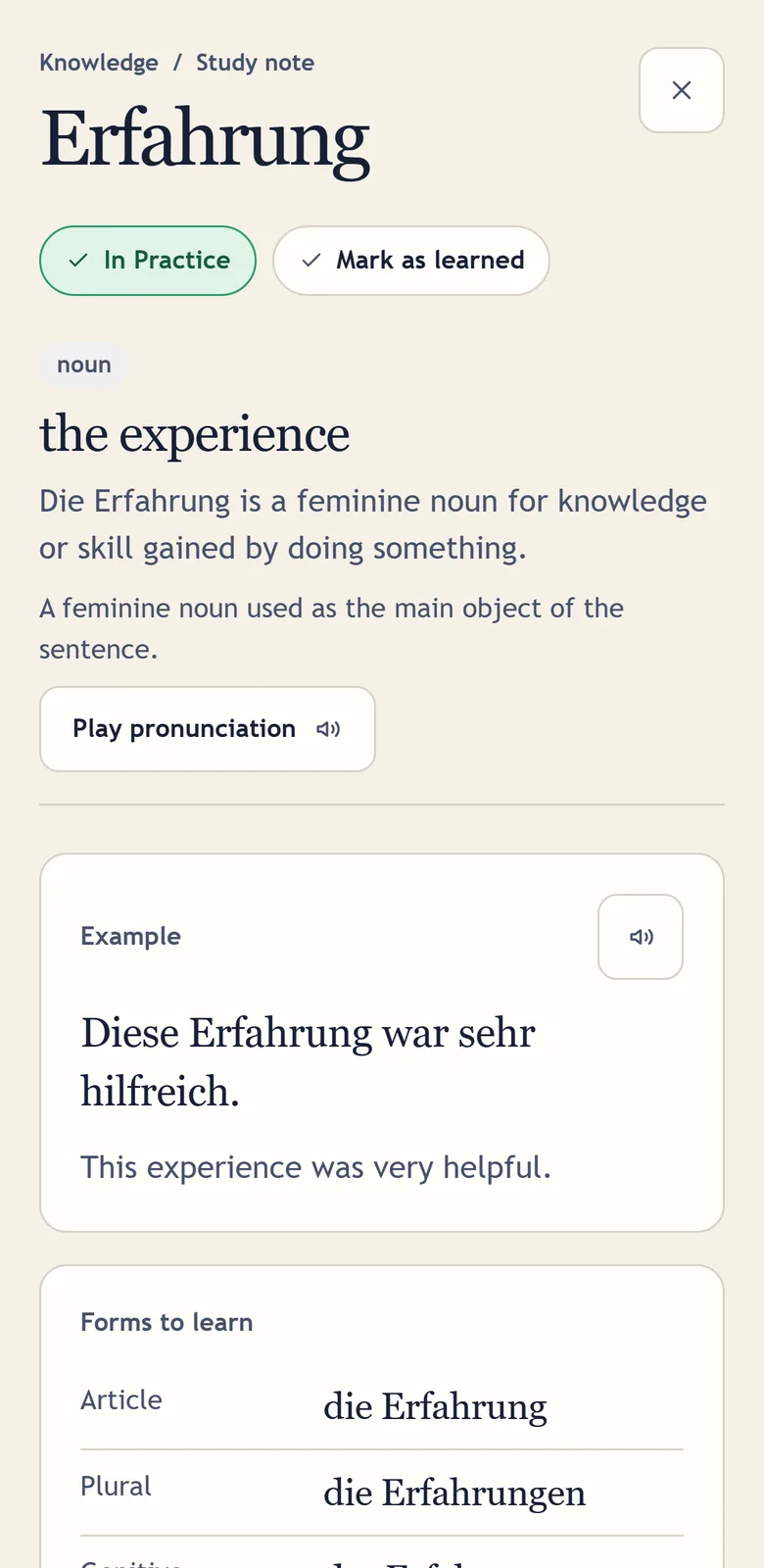
When you tap a noun in Linota, its article and plural appear with the meaning, in the sentence you found it in. Save it, and the study note keeps both, so you always learn der Zug together with die Züge. Your review cards then bring the word back when they are due. Blitz and the crossword give you the same words again in a faster, lighter form.
The short version
- Five patterns: -e, -(e)n, -er, no ending and -s.
- Feminine nouns: almost always -(e)n, with no umlaut.
- Masculine nouns: usually -e, often with umlaut; -er, -el, -en stay the same.
- Short neuter nouns: -er with umlaut or -e; longer ones follow their ending.
- -s for vowel endings, loanwords and short forms.
- Dative plural: add -n, unless the plural ends in -n or -s.
The surest way is still to learn every noun with its article and its plural. How to learn German vocabulary shows how to make them stay.
Questions people ask
What is the most common plural ending in German?
Among all nouns, -(e)n is the most common, because almost every feminine noun takes it: die Zeitung, die Zeitungen. For masculine nouns, -e is the usual ending, and for short neuter nouns -er or -e.
Is there a rule for the umlaut in German plurals?
Only a partial one. The umlaut never appears with -s or -(e)n, and it always appears with -er when the vowel can take one (das Buch, die Bücher). With -e and with no ending it varies, so learn der Zug, die Züge as one unit.
Do all plurals use the article die?
Yes. In the nominative and accusative every plural takes die, whatever the gender in the singular. In the dative the article is den, and in the genitive der.
Why do some German nouns have no plural?
Some nouns name things you do not count, such as die Milch, das Obst or das Gepäck. To count them you add a word: zwei Flaschen Milch, drei Gepäckstücke. A few others, such as die Leute and die Eltern, exist only in the plural.