How to learn German vocabulary so it actually stays
The best way to learn German vocabulary is to start from the words you actually meet, learn each one in the sentence you found it in, keep nouns with their article and plural and verbs with their past forms, and then review the words at growing intervals by recalling them yourself instead of rereading them. Ten to fifteen minutes a day is enough. What matters is that every word comes back a few times, in context, until you can use it.
Why do German words not stick?
Because we usually meet them once. You look up die Verspätung on Monday, understand it, and by Friday it is gone. Memory works like that for everyone: a new word fades fast unless it returns. Three habits make it worse:
- Learning from lists of words you will not meet. A word with no use in your life has no reason to stay.
- Learning the bare word. Verspätung without its article and an example is half a word, and you will have to learn the other half later.
- Rereading instead of recalling. Looking at a word and its meaning feels like learning, but trying to remember it before you look is what makes it stay.
The fix is not more effort. It is a different routine.
Which German words should you learn first?
Start with the words of your own life. If you take the train to work, you need der Zug, das Gleis, die Verspätung and umsteigen long before you need the words for farm animals.
Der Zug hat zehn Minuten Verspätung.
The train is ten minutes late.
In Köln muss ich umsteigen.
I have to change trains in Cologne.
Then fill the gaps with the most frequent words of the language: the small verbs (haben, machen, gehen, sagen), the question words and the everyday nouns. Our list of the most common German words shows which ones carry the most weight.
How do you learn a German word properly?
Learn it with everything you need to use it. That means a little more than the translation, and it saves you trouble later.
| Word type | What to keep with it | Example |
|---|---|---|
| Noun | article and plural | die Verspätung, die Verspätungen |
| Verb | past forms, and haben or sein | fahren, fuhr, ist gefahren |
| Separable verb | the prefix that moves | anrufen: Ich rufe dich an. |
| Adjective | anything irregular | gut, besser, am besten |
| Any word | one real sentence | Ich habe den Zug verpasst. |
The article is the part learners skip most often and regret most. Zug on its own tells you nothing; der Zug tells you how to say "the train", "a train" and "on the train". There is a whole guide to der, die, das if articles are your weak spot.
Why does context beat word lists?
A word in a sentence brings its grammar along. When you save verpassen from the sentence below, you also see that it takes an object in the accusative and forms its past with haben.
Ich habe den Zug verpasst.
I missed the train.
Ich rufe dich morgen an.
I'll call you tomorrow.
Context also gives the word a place in your memory: the article you were reading, the sign you saw at the station. That is why reading German at your level is one of the best sources of vocabulary. You meet words in good sentences, and you meet the common ones again and again without trying.
What is spaced repetition, and does it work?
Spaced repetition means reviewing a word when they are due: after a day, then a few days, then a week, then a month. Each successful review pushes the next one further away. It is one of the best researched methods in learning, and it works because it spends your time on the words that are fading, not on the ones you already know.
The important part is how you review: see the English or a sentence with a gap, try to produce the German, then check. Struggling a little is the point. Our guide to spaced repetition for German sets out a simple daily routine.
How do you go from knowing a word to using it?
Understanding a word and being able to say it are two different stages. To move a word across:
- Say it out loud in a sentence of your own. Ich habe heute fast den Bus verpasst.
- Write it. One short message or diary line with three new words is enough.
- Learn phrases, not only words. Germans speak in chunks, and chunks are ready to use.
Ich hätte gern einen Kaffee.
I'd like a coffee.
Das kommt darauf an.
It depends.
Kannst du mir kurz helfen?
Can you give me a hand for a moment?
Phrases like these carry their grammar with them, so you get correct German without building it word by word.
How many German words do you need?
Fewer than you might fear. The official exam word lists give a feel for it: roughly 650 entries for A1, about 1,300 for A2 and about 2,400 for B1. Most learners understand far more words than they can use, which is normal. Aim to understand widely and to use a smaller core really well.
How does Linota help you learn German vocabulary?
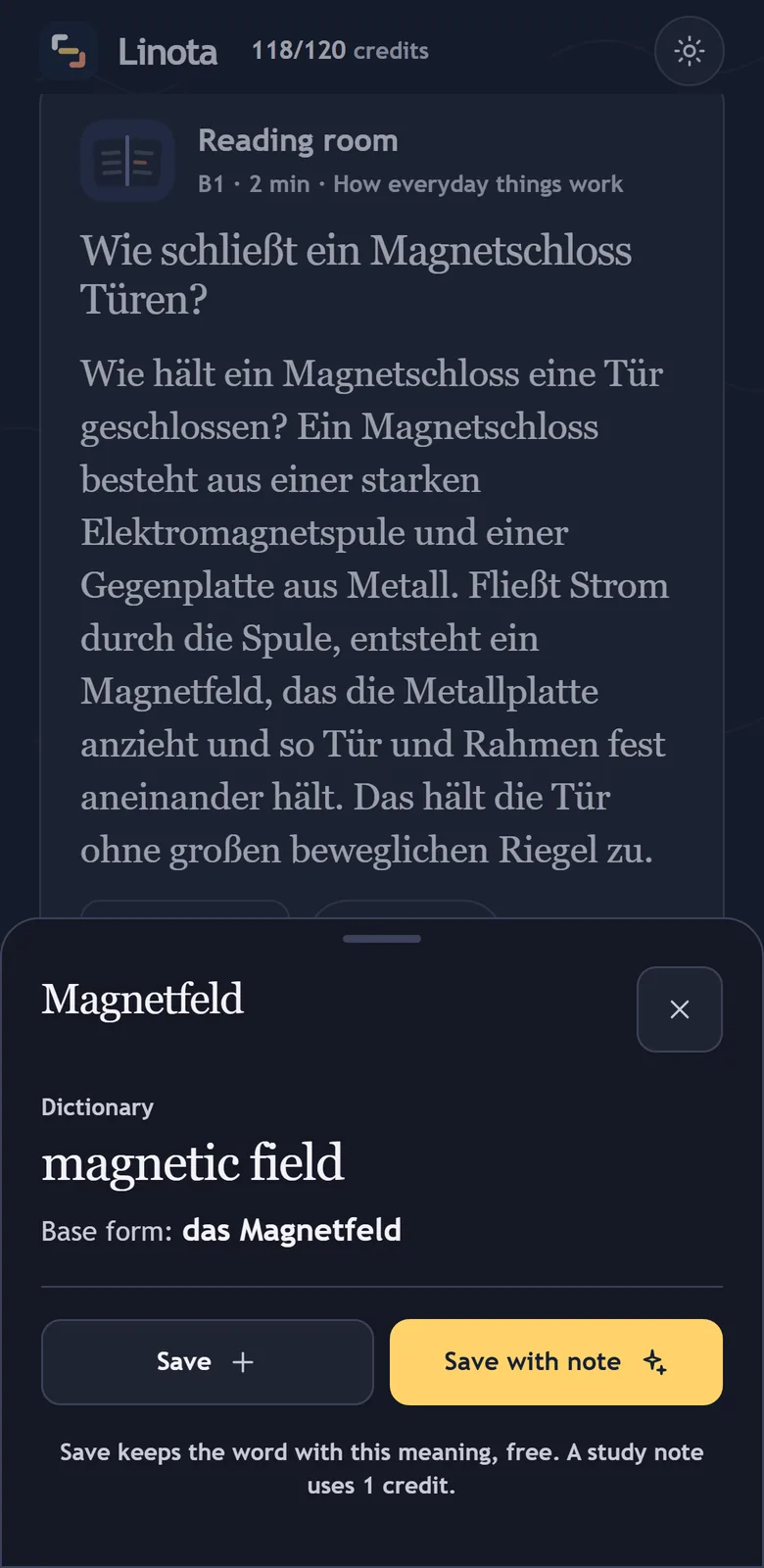
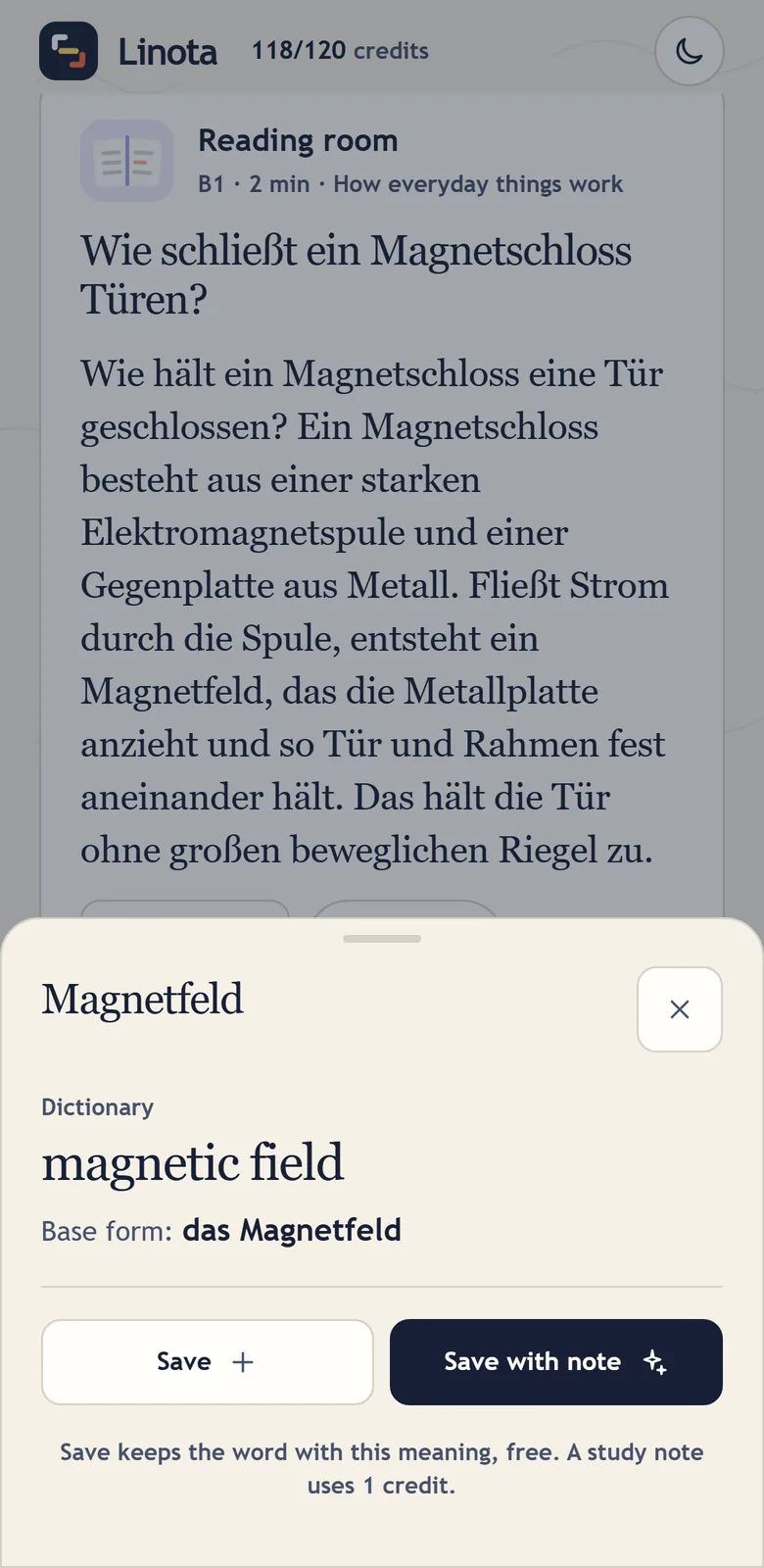
Linota is built around this routine. You tap any word you meet, in the morning's reading, the news, an ebook, a YouTube video's subtitles or a page you scanned, and it is explained in the sentence you found it in, with its article, plural or past forms. One more tap saves it with a study note. Your saved words then come back as review cards when they are due, and in the quiz, Blitz, the crossword and Endungs-Poker, so you recall them in different ways instead of rereading a list.
The short version
- Learn the words you actually meet, then fill the gaps with the most common ones.
- Keep nouns with their article and plural, verbs with their past forms, and every word with a sentence.
- Recall words before you check them, and review them at growing intervals.
- Use new words in sentences of your own and learn useful phrases whole.
- Ten to fifteen minutes every day beats an hour once a week.
If you want to build this into your day, read how to learn German in ten minutes a day.
Questions people ask
How many German words should I learn a day?
Five to ten new words a day is plenty for most adults with a job, as long as you also review the older ones. Ten words a day adds up to over three thousand in a year, which is more than you need for B1.
Is it better to learn German words from lists or from texts?
Texts, mostly. A word you met in a sentence comes with its meaning, its grammar and a memory of where you saw it. Lists of common words are useful as a check on what you might be missing, not as your main source.
Why do I forget German words so quickly?
Forgetting is normal: memory fades quickly after a first meeting unless the word comes back. Reviews at growing intervals, recalling the word yourself instead of rereading it, and using it in a sentence all slow the forgetting down.
How many words do I need for B1 German?
The official exam word lists give a feel: roughly 650 entries for A1, about 1,300 for A2 and about 2,400 for B1. Real learners know more words passively than they can use, and that is fine.