Spaced repetition for German: a simple daily routine
Spaced repetition is a way of reviewing German words when they are due. A new word comes back after a day, then after a few days, then after weeks and months, and every correct answer pushes the next review further away. You spend your time on the words that are slipping, not on the ones you already know. Ten minutes a day of spaced repetition flashcards, built from German you have really met, is enough to keep a growing vocabulary for good.
What is spaced repetition, and why does it work?
In the 1880s the German psychologist Hermann Ebbinghaus tested his own memory with lists of nonsense syllables and found what we now call the forgetting curve: we forget a large part of something new within a day or two unless we meet it again. He also found that each time we relearn it, we forget it more slowly.
Spaced repetition uses both findings. Two things make it work:
- Retrieval. Pulling a word out of your memory, with the answer hidden, strengthens it far more than reading it again. That is why a flashcard beats a word list.
- Spacing. A review is most useful when the word has started to fade. If you review it while it is still fresh, you learn little; if you wait until it is completely gone, you start from zero.
The result feels a little uncomfortable, because you often have to search for the answer. That effort is the point: it is the moment your memory decides the word is worth keeping.
How often should you review a new German word?
There is no magic timetable, and good apps adjust the gaps to your answers. A typical pattern for a word you keep getting right looks like this:
| Review | Roughly when | What usually happens |
|---|---|---|
| 1 | the next day | you remember it with some effort |
| 2 | 3 to 4 days later | it feels familiar again |
| 3 | about a week later | the article and plural start to stick |
| 4 | two to three weeks later | you recognise it without thinking |
| 5 | one to three months later | it is part of your German |
When you get a word wrong, it goes back to a short gap and climbs again. This is the idea behind the Leitner box, a paper system with several compartments that the science journalist Sebastian Leitner described in the 1970s: cards you know move to the next compartment and wait longer, cards you miss go back to the first.
What should go on a German flashcard?
A card that only says "appointment" on one side and Termin on the other teaches you half a word. German needs a little more:
- Nouns: the article and the plural, so der Termin, die Termine, never just Termin.
- Verbs: the forms you cannot guess, for example fahren, fährt, ist gefahren.
- Prepositions that belong to a word: warten auf, sich freuen über.
- One real sentence, ideally the one where you found the word.
Ich habe morgen um neun einen Termin beim Arzt.
I have a doctor's appointment at nine tomorrow.
Der Zug ist schon abgefahren.
The train has already left.
Kannst du mir kurz helfen?
Can you give me a hand for a moment?
The sentence does quiet work. einen Termin reminds you that the word is masculine, and ist abgefahren shows you that the verb takes sein in the Perfekt. If articles are your weak spot, der, die, das rules shows the patterns that help you guess them.
German to English, or English to German?
German to English tests whether you recognise a word; English to German tests whether you can produce it, which is harder and closer to speaking. Start new words in the easier direction. For the words you want to use yourself, such as the German of your job or your flat, add the second direction once the first is easy.
What does a simple daily routine look like?
A routine you can keep for a year beats a perfect one you drop after a week. This one takes about ten minutes:
- Reviews first. Clear the cards that are due today before you add anything new. This takes two to five minutes once the habit is running.
- Add five to ten new words. Take them from something you read or heard today, not from a random list.
- Say every answer out loud. Your mouth learns the word along with your eyes, and you practise pronunciation at the same time.
- Grade yourself honestly. If you hesitated for a long time or got the article wrong, mark it wrong. Kind grading only fills next month with words you never knew.
- Stop. A short session every day does more than a long one on Sunday.
Can you learn German in ten minutes a day? looks at how to build this into a day that is already full.
Which mistakes make flashcards stop working?
Most people who give up on flashcards were not lazy. They fell into one of these traps:
- Too many new cards at once. Two hundred words in a weekend turns into hundreds of reviews a week later.
- Words with no context. A card made from a frequency list has no story behind it and fades quickly. Words from your own reading stay better, which is why the most common German words are best met in sentences, not in columns.
- Bingeing and skipping. Spacing only works when the reviews happen near their dates. Five minutes daily beats an hour once a week.
- Cards that are too big. One word or one short phrase per card. If a card has three things to remember, split it.
- Recognition only. If you never test German from English, you will understand words you cannot say.
How does Linota help with spaced repetition?
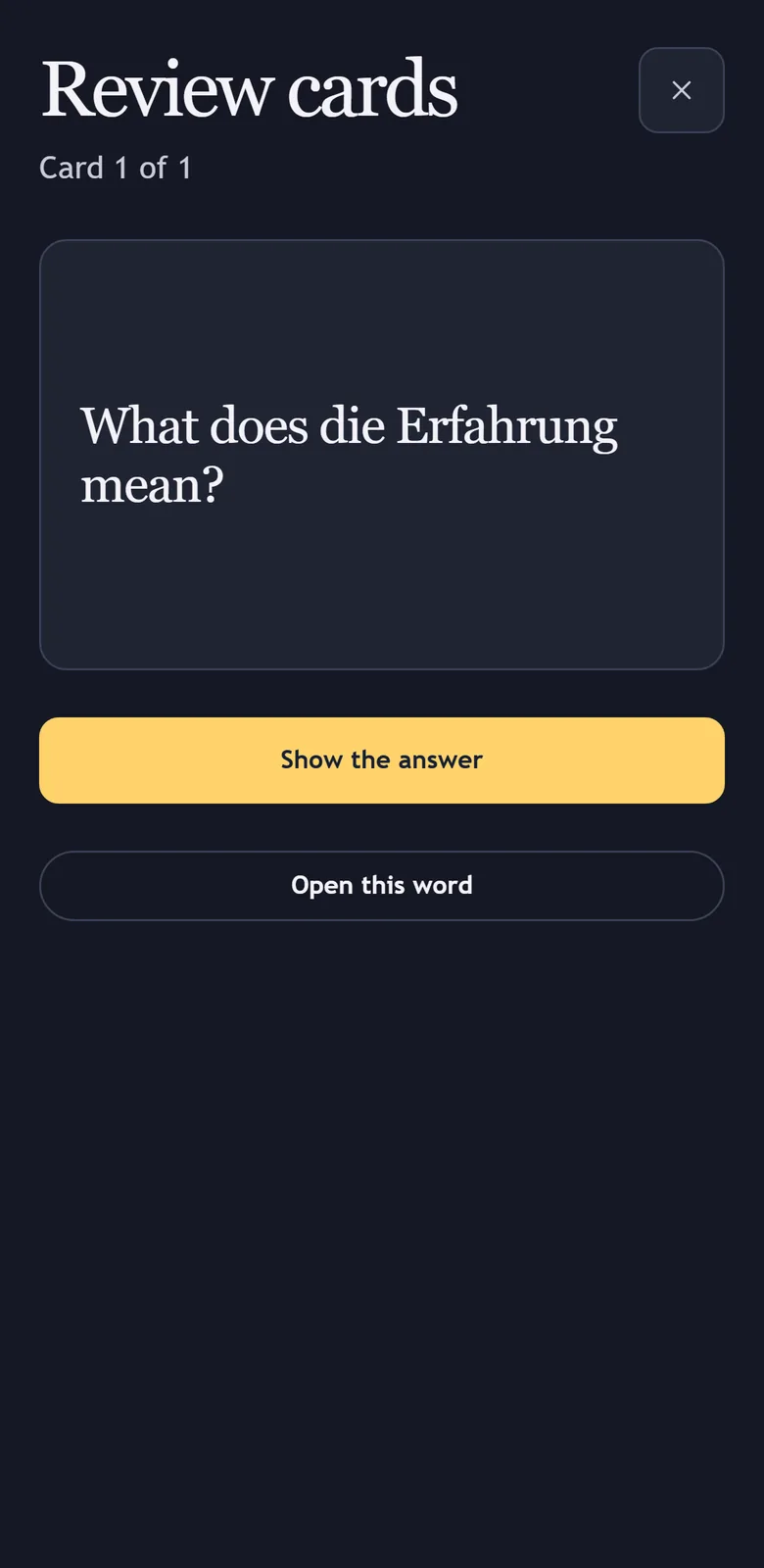
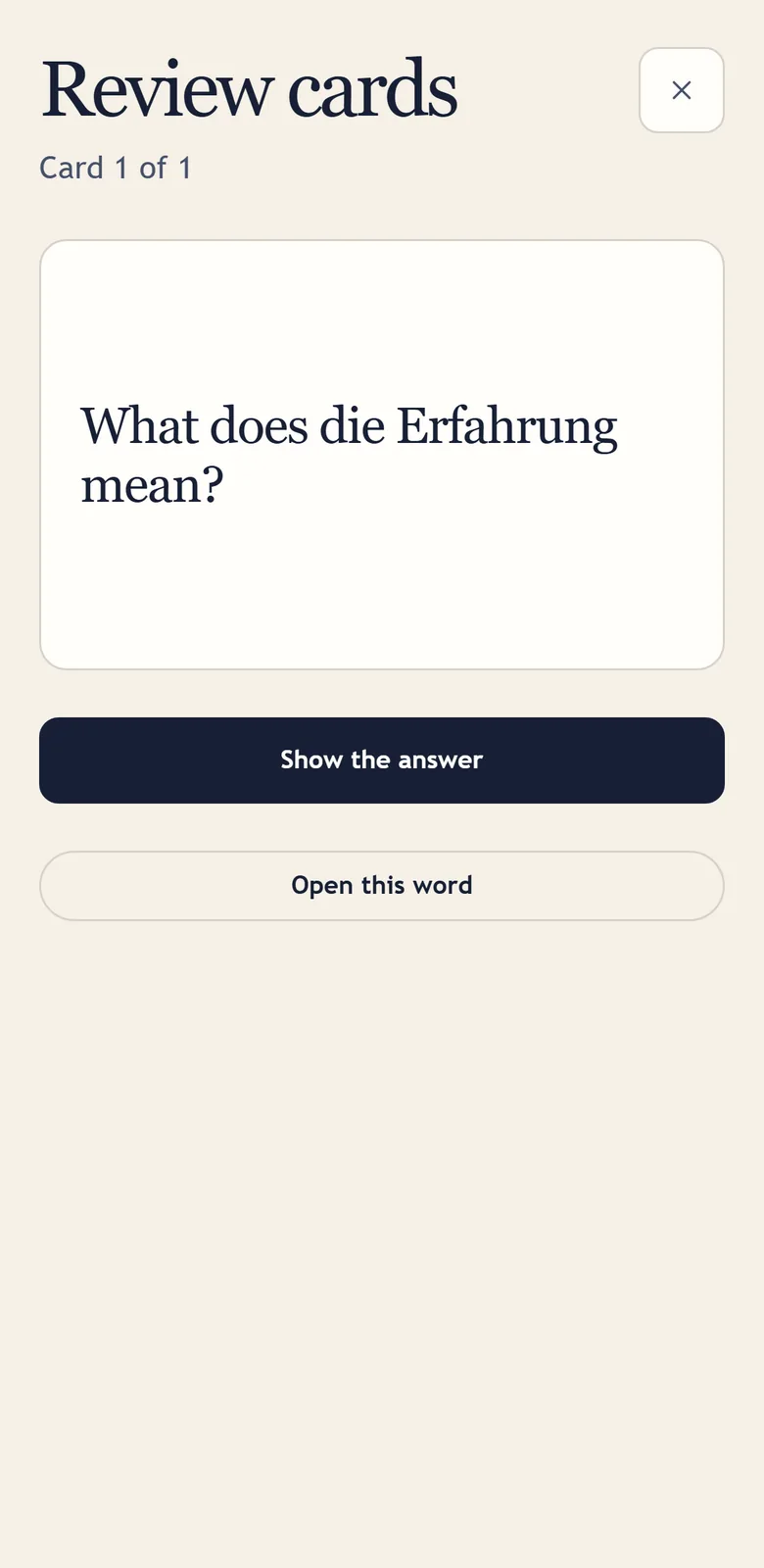
In Linota you collect words by tapping them where you meet them: in the morning's short text in the Reading room, in a piece of news, in a page you scanned or a video you watched with German subtitles. One more tap saves the word with a study note that explains its article, its plural or past forms and how it is used. Your review cards then come back when they are due, so the spacing is done for you, and the quick quiz and the games mix in the same words from other angles.
The short version
- Spaced repetition brings each word back just as it starts to fade.
- Hide the answer and pull it out of memory: that is what makes a word stick.
- Put the article, the plural or the past forms and a real sentence on every card.
- Reviews first, then five to ten new words, every answer said out loud.
- Grade honestly and keep the sessions short and daily.
Spaced repetition keeps words; it does not find them. For the whole picture, from collecting words to using them, read how to learn German vocabulary so it actually stays.
Questions people ask
How many new German words should I add a day?
For most adults five to ten new words a day is plenty. Every new card brings several reviews over the following weeks, so a big batch today becomes a pile of reviews next week. Keep the number small and steady rather than large and occasional.
What happens if I miss a day of reviews?
Nothing dramatic. The cards that were due simply wait, and you clear them over the next day or two. Do the reviews first and add no new words until you have caught up.
Should I put whole sentences on my German flashcards?
Put one short, real sentence on the card next to the word, ideally the sentence where you met it. You still test yourself on the word, but the sentence shows you how it is used and reminds you of its article and endings.
Is spaced repetition enough to learn German?
No, it is a way to keep words, not a way to meet them. You still need reading, listening and speaking to find new words and to use the ones you know. Think of spaced repetition as the part of your routine that stops you forgetting.