Reading German at your level: how graded texts build fluency
The best German reading practice is reading a lot of text that is just right for your level: easy enough that you follow it without a dictionary, hard enough that you meet a few new words on each page. Graded texts are written for exactly that, with vocabulary and grammar limited to a CEFR level. Read them regularly, look up only the words that matter, and your vocabulary, your grammar and your speed grow together, without drills.
Why is reading so good for learning German?
Reading gives you German at your own speed. You can stop, look again and notice things that fly past in conversation:
- Words in context. You meet a word in a sentence, so you learn how it is used, not just what it means.
- Articles and endings, over and over. Every page shows you der, die and das doing their jobs, which is how the patterns become a feeling.
- Word order. You see the verb go to the end after weil and dass hundreds of times before you have to produce it.
- Repetition you do not notice. Common words come back in every text, so they settle in memory without flashcards.
Reading is also the one skill you can practise anywhere, alone, in small pieces: on the train, in a waiting room, before bed.
How do you know if a text is at your level?
A simple check: read the first paragraph. If you understand the gist and meet one or two unknown words in the whole paragraph, the level is right. If you need a dictionary for every line, the text is too hard for now, however interesting it is.
Studies of reading in a foreign language point the same way: comfortable reading needs you to know the great majority of the words on the page, roughly 95 percent or more. Below that, you are decoding, not reading.
Here is roughly what you can handle at each level:
| Level | What you can usually read |
|---|---|
| A1 | signs, short messages, simple forms, a few sentences about everyday things |
| A2 | short emails, notices, simple adverts and texts about familiar topics |
| B1 | easy news, blog posts, clear texts about work, travel and daily life |
| B2 | most newspaper articles and non-fiction on topics you know |
| C1 | long, complex texts, including literature and specialist articles |
If you are not sure where you stand, German levels A1 to C1 explained describes each level in more detail.
What should you read at A1, A2, B1 and B2?
- A1 and A2: graded readers (short stories written for a level, often with a glossary), short texts written for learners, and the German around you: signs, menus, letters from your landlord. Real-life texts are short and you have a reason to understand them.
- A2 and B1: news written in simple German, such as Deutschlandfunk's nachrichtenleicht or the learner pages of Deutsche Welle, plus graded readers one level up.
- B1 and B2: ordinary news sites, magazines, blogs about your hobbies and non-fiction on subjects you already know in your own language. Familiar content makes unfamiliar German much easier.
- B2 and beyond: novels, opinion pieces, long articles. A book you have already read in translation is a gentle first novel.
Here is the kind of German you meet every day at A2 level, and it is worth reading closely:
Wegen Bauarbeiten fällt die S1 am Wochenende aus.
Because of engineering works, the S1 is cancelled at the weekend.
Bitte bringen Sie Ihren Ausweis mit.
Please bring your ID with you.
Die Praxis bleibt vom 5. bis 9. August geschlossen.
The practice will be closed from 5 to 9 August.
Intensive or extensive reading: which is better?
You need both, in different amounts.
Extensive reading means reading a lot of easy text, quickly, for the content. You skip unknown words unless they block the meaning. This is where your speed and your feeling for German come from, and it should be most of your reading.
Intensive reading means taking a short text, perhaps half a page, and working through it closely: every unknown word, every sentence you cannot quite explain. It is slow and tiring, so keep it short, once or twice a week.
How should you read a German text?
- Read once for the gist. Do not stop. What is it about, who does what?
- Guess before you look up. The context, the shape of the word and its parts often give the meaning away. Long words are usually several short ones joined together, and how to read long German words shows how to take them apart.
- Look up only what matters. Words that come back, or words without which the sentence makes no sense.
- Save a few words, not all of them. Five useful words from a text are better than twenty you will never review.
- Reread it a day later. The second reading is faster and more pleasant, and it fixes the words you saved.
How does Linota help with reading?
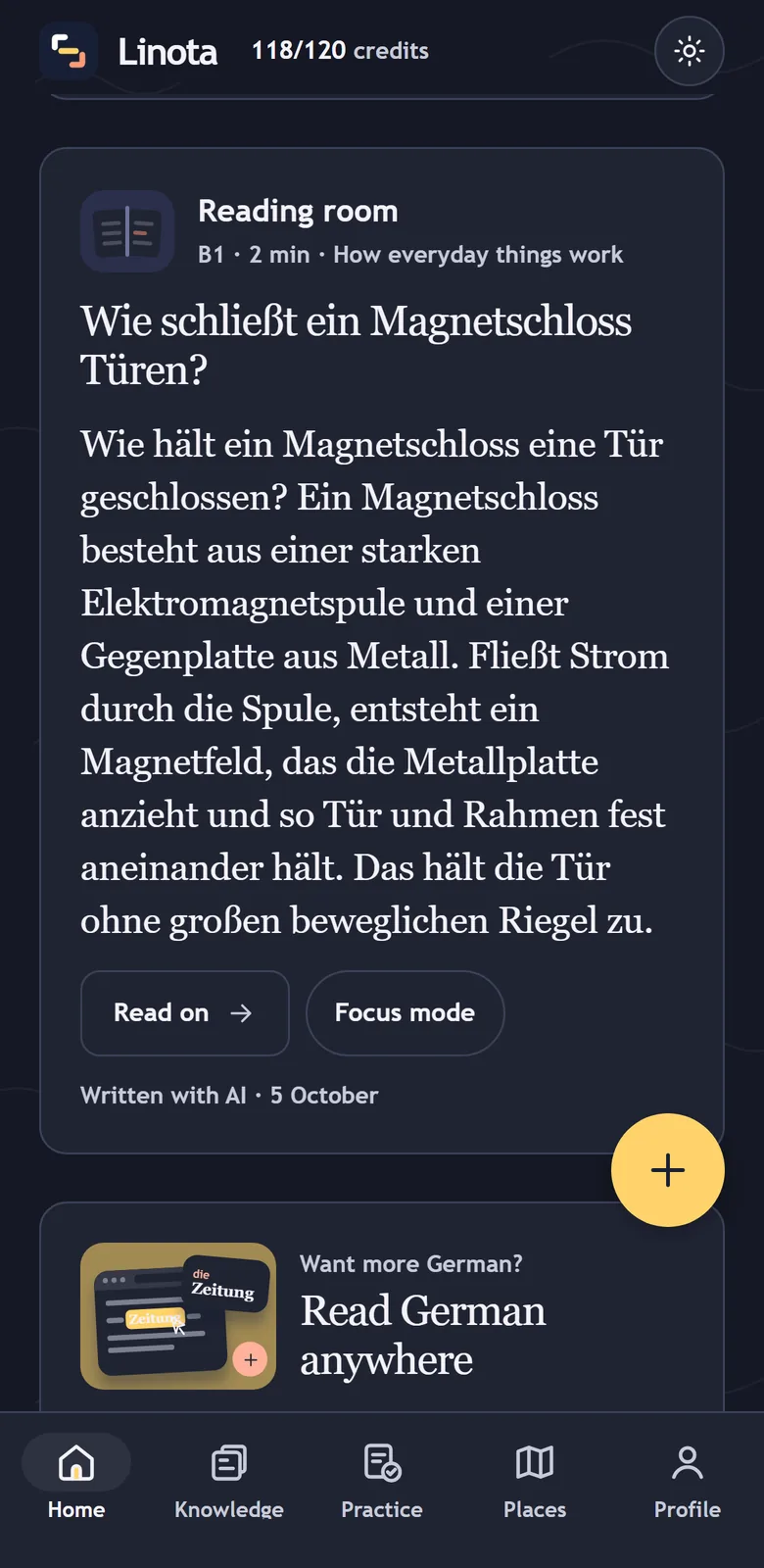
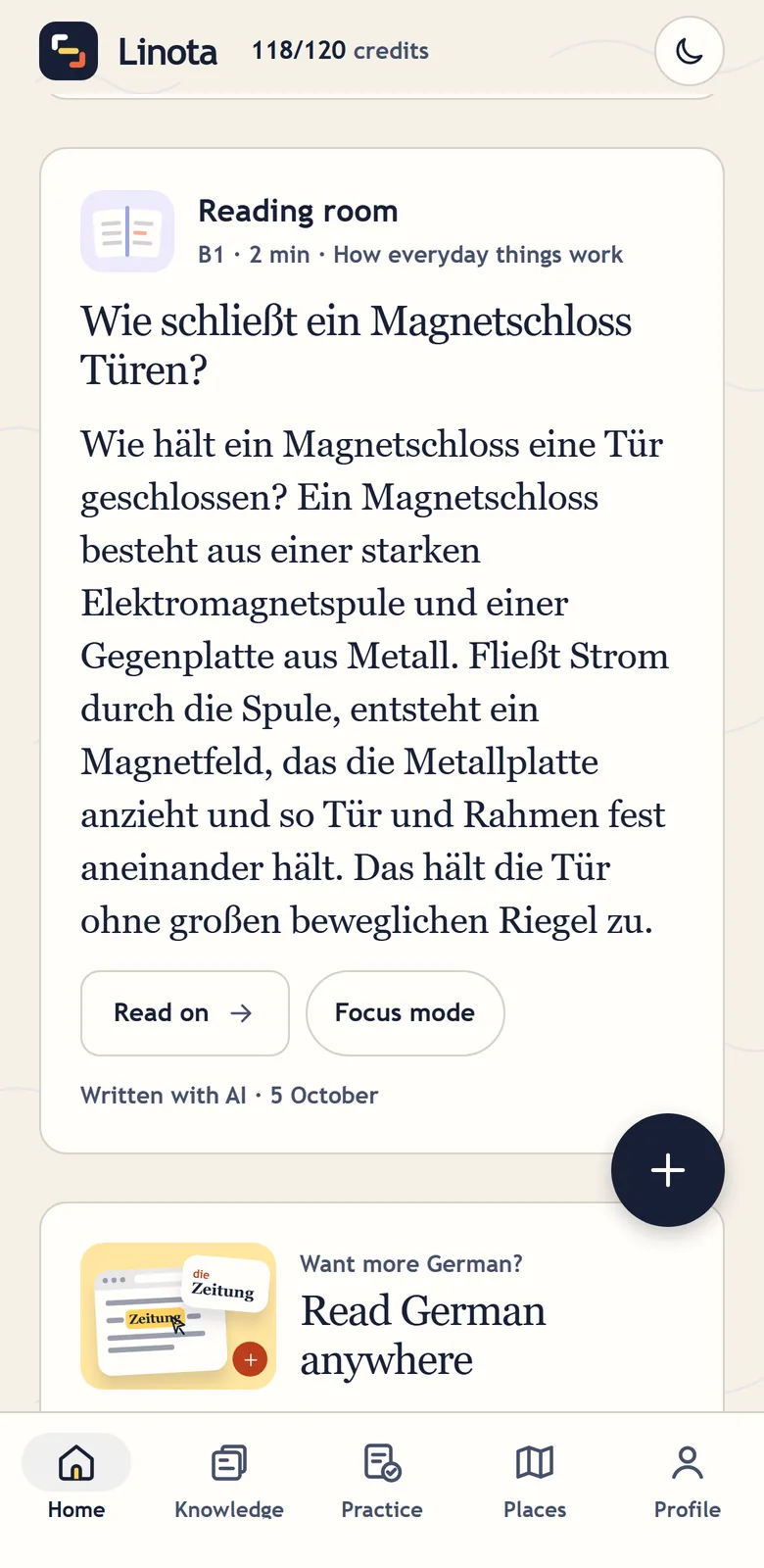
Every morning Linota's Home brings a short text in the Reading room at your level, along with a little of the day's news, all in German you can tap. Tap any word and its meaning appears in the sentence you found it in; one more tap saves it, with a study note on its article, plural or past forms. You can also open your own German: share an article from Safari, open an ebook (EPUB), a PDF or a text file, or scan a page with the camera, and read it the same way.
The short version
- Choose texts where you meet only one or two unknown words a paragraph.
- Read a lot of easy German, and study one short text a week closely.
- Guess first, look up only what matters, save a few words, not all.
- Start with German from your own life: notices, letters, news in simple German.
- Reread the next day.
Reading is how you meet words; reviewing is how you keep them. For the whole method, read how to learn German vocabulary so it actually stays, and for listening at your level see learning German from podcasts, YouTube and books.
Questions people ask
How many words should I know to read a German text comfortably?
Research on reading in a foreign language suggests you need to know the great majority of the words, roughly 95 percent or more, to follow a text without strain. In practice, if you meet more than one or two unknown words in every line, the text is too hard for now.
Are children's books good for learning German?
Picture books and early readers use simple sentences, but their vocabulary is often about animals, castles and bedtime rather than adult life. Graded readers and easy news written for adults usually teach you more useful German for the same effort.
Should I look up every word I don't know?
Not when you read for pleasure. Look up only the words that keep coming back or that stop you from understanding the sentence. In a short text you study closely, looking up more is fine.
Should I read German out loud?
Sometimes, yes. Reading a short passage aloud trains pronunciation and helps you notice word order, but it is slower and tires you sooner. Do most of your reading silently and read a paragraph aloud now and then.